The unclear state of Iran–Lebanon relations
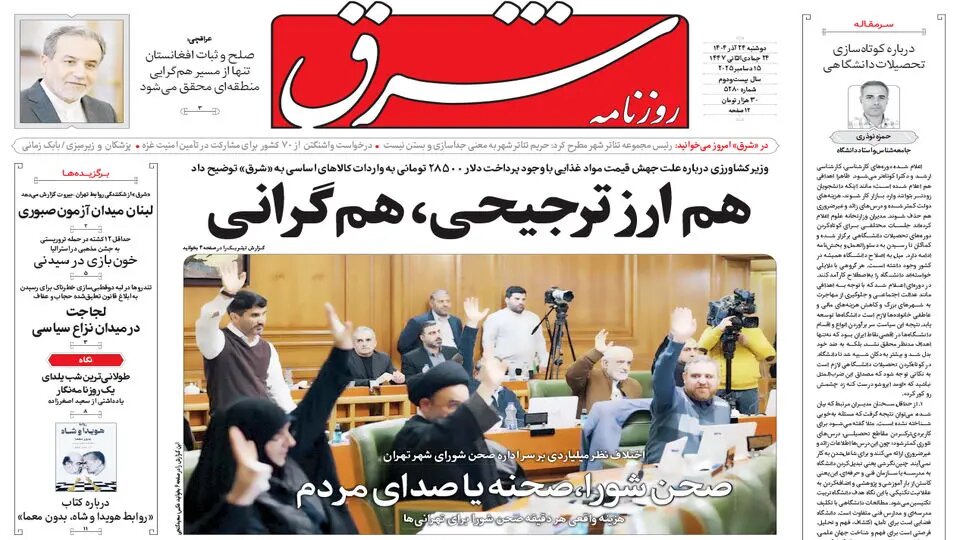
TEHRAN - Shargh examined why Lebanon insists on dialogue with Tehran over sensitive issues in third countries.
It argued that Lebanon’s government sees relations with Iran as far from normal, preventing direct talks. Another factor is Beirut’s effort to maintain distance from Tehran—whether to redefine Lebanon’s position in regional blocs, to avoid U.S. backlash, or to ease American pressure. Lebanon currently faces a highly fragile situation: with Israel and the U.S. setting deadlines for Hezbollah’s disarmament, the risk of another large-scale war looms. In this context, Lebanon’s new rulers believe Tehran is part of the equation. Although they are under heavy pressure from Washington, Tel Aviv, and others to intensify disarmament efforts, this demand also reflects a long-standing aspiration of certain Lebanese political forces. Facing Hezbollah’s staunch resistance, Lebanese officials argue that the key lies in Tehran. For this reason, they link the preservation and strengthening of bilateral ties—whether through unusual formats of dialogue or public statements—to the prospect of Hezbollah’s disarmament.
Etemad: Europe’s decline to a secondary player in Western bloc
Etemad reflected on Europe’s diminished role in the emerging global order. It noted that Europeans, as the ‘traditional powers’ of international relations, never imagined—even in their worst nightmares—that to remain in the ‘club of the powerful’ they would have to go to such desperate lengths. The war in Ukraine revealed that Europe, instead of standing as one of the three main poles alongside the U.S. and China, is becoming a subordinate branch of the American bloc. Europe may remain wealthy and democratic, but it has effectively lost the ability to shape global events independently. This decline, especially after the Ukraine war, has had both direct and indirect consequences for Iran’s nuclear file and related diplomacy. The main reason is Europe’s diminished strategic autonomy vis-à-vis Washington and its prioritization of hard security. As a result, Europe has become merely a “catalyst” in U.S.–Iran relations, acting as the “bad cop” to satisfy Washington. With its diminished weight, Europe can no longer balance Iran and America in nuclear negotiations and is compelled to fully follow the U.S. sanctions policy.
Arman-e-Melli: Tehran-Beijing ties advancing rapidly
Arman-e-Melli analyzed the third Iran–China Dialogue Forum. It said economic and political cooperation between the Islamic Republic and China is advancing rapidly. Both countries frame this trajectory as part of a shared strategy to counter U.S. “unilateralism” in the international system. On the economic front—of particular importance to Iran—the 25-year comprehensive cooperation agreement remains the backbone of bilateral ties. China, as one of Iran’s most significant trading partners, has played a crucial role in sustaining Tehran’s level of economic exchange under international restrictions. Alongside economic collaboration, political developments—especially Iran’s nuclear file—have become arenas for synergy among Tehran, Beijing, and Moscow. These dynamic gains added weight as Iran and China approach the 55th anniversary of their diplomatic relations. The symbolic milestone offers an opportunity to redefine and deepen cooperation within a shifting global order, one in which Tehran and Beijing seek to consolidate more independent positions against Western political and economic pressures.
Khorasan: Intensified mediation efforts in West Asia
Khorasan reflected on mediation efforts aimed at stabilizing Syria through dialogue between Iran and Hezbollah. It noted that, in a region where crises flare intermittently, Turkey and Qatar have assumed relatively quiet roles as mediators, attempting to bring Iran, Hezbollah, and Damascus close to an understanding. In the Syrian capital, certain groups look to Tehran and Beirut for shelter and balance against Israeli pressure. Meanwhile, semi-hidden and intensive consultations continue in Tehran and Beirut, where Damascus’s goodwill and guarantees for Lebanon’s eastern border security are seen as essential conditions for sustained cooperation. Recent moves by Turkey and Qatar in mediating between Iran, Hezbollah, and Syria signal attempts to redefine regional balances, though they face serious obstacles. While these efforts appear diplomatic and conciliatory, they in fact reflect multilayered pressures, hegemonic rivalries, and the urgent need to manage security threats in Syria and Lebanon. Ongoing discreet negotiations, though weak in media visibility, reveal the complex layers of talks and the pursuit of a fragile balance. Any success in this path requires concrete guarantees, operational transparency, and careful management of both local and regional actors.
Leave a Comment